Here is a number that surprises people: the ICT sector, which includes data centers, networks, and devices, produces roughly 1.5 to 4 percent of worldwide greenhouse gas emissions. That puts it in the same range as the aviation industry. 😱
Engineers are in a unique position to collectively decarbonize millions of tonnes of Co2 from behind their laptops. They make infrastructure decisions every day, but the impact of those choices is rarely visible. Cost savings in particular can feel distant. When someone switches from a c5.24xlarge to a more efficient c8g.24xlarge, they do not see the two thousand dollars saved each year. That win ends up in a finance spreadsheet and feels abstract.
What we learned early on is that many engineers care just as much about environmental impact as they do about cost. That came into focus when one of our early access users reviewed a pull request suggesting a newer instance type. It saved money, but this one infrastructure tweak would also prevent more carbon emissions over the next year than their entire team would generate flying to their upcoming offsite in Spain.
Suddenly, it was not about the company’s cloud bill. It was personal.
Why visibility changes behavior
Every deploy pulls energy from a grid, powers cooling systems, and contributes to a footprint that engineers never see. Data center energy usage continues to grow faster than global electricity consumption, which makes this hidden impact even more important to understand.
The issue has never been a lack of interest. Engineers care. They have simply never had this information at the moment decisions are being made.
Until now.
Introducing InfraCarbon
Starting today, Infracost Cloud shows the carbon impact of your infrastructure changes directly in your pull requests — right next to the cost information you already rely on.
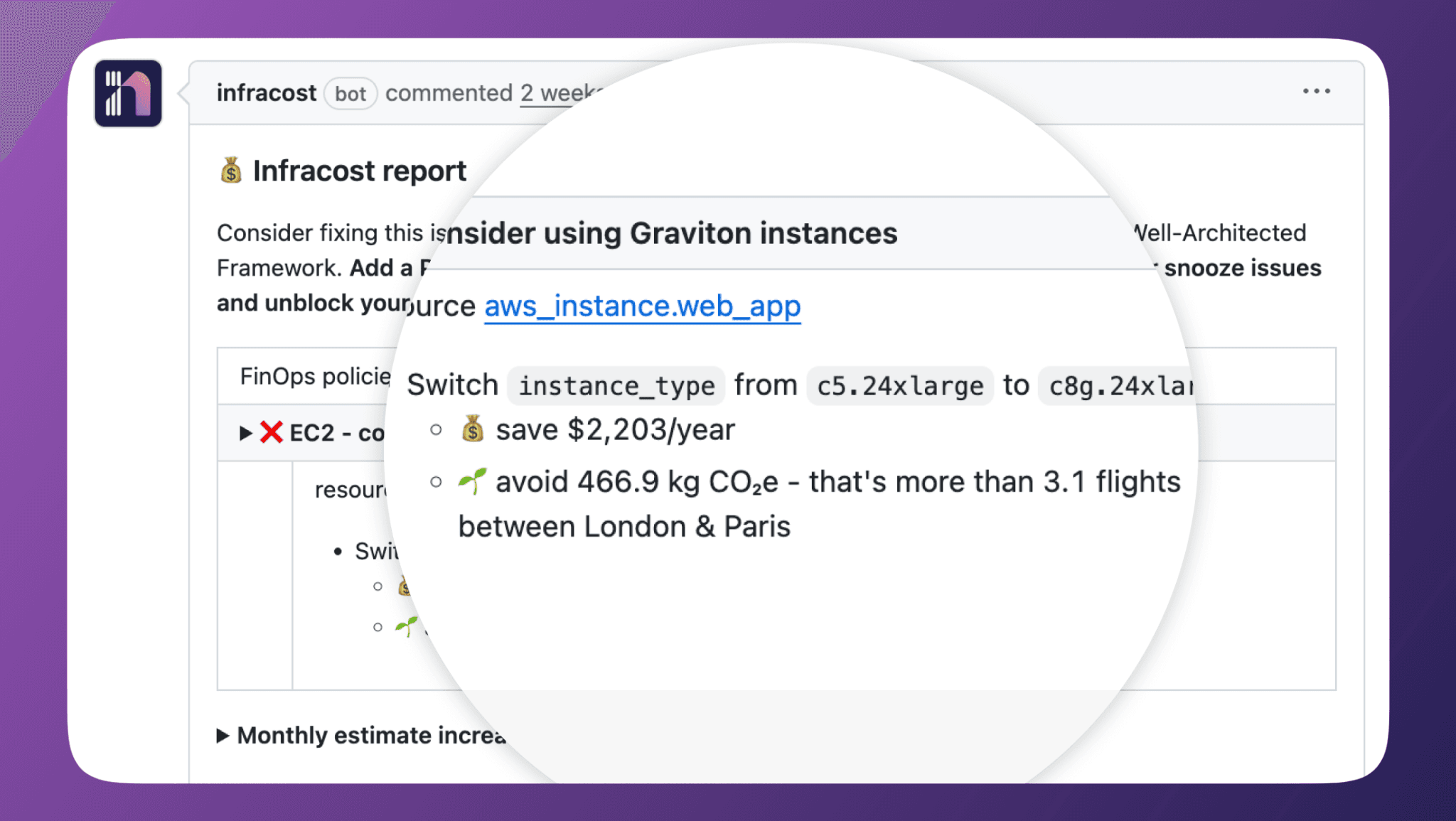
🌱 avoid 450kg CO₂e — about the same as three flights between London and Paris
We translate technical carbon numbers into real-world equivalents because “450kg of CO₂e” doesn’t mean much. But “three flights avoided” does. It’s simple. It’s relatable. And for many engineers, it’s a more motivating signal than “$2,203 saved.”
Powered by real carbon data
We partnered with the team at Greenpixie to bring this to life. They specialize in understanding the environmental impact of cloud infrastructure and account for factors like grid emissions, hardware characteristics, and regional differences.
Their emissions intelligence now powers InfraCarbon across AWS, Azure, and Google Cloud, giving engineers a practical way to factor sustainability into their day-to-day work.
As part of the partnership, engineers who want to go deeper can access Greenpixie’s Cloud Sustainability Fundamentals program through the GreenOps Academy. More than 1,500 students have already completed the course, and InfraCarbon users are welcome to enroll for free if they want a stronger grounding in how cloud emissions are calculated and what drives them.
This creates a simple win for teams. The choices that reduce emissions often reduce costs at the same time. Even if someone is not motivated by climate impact, the fact that developers care about this and act on it also helps the business save money.
This partnership is also a first step toward building a broader ecosystem around FinOps and sustainability. Greenpixie brings credibility in the climate space; Infracost brings distribution and engineering workflow visibility. Together, we can reach developers who care about more than costs.
Why this matters more than ever
Many companies are being asked to report on their cloud-related emissions, and cloud is becoming a larger part of sustainability reports. The challenge is that these numbers usually show up months after the decisions that created them.
By then, it’s too late to fix anything.
InfraCarbon shifts that visibility left — to the moment when engineers are deciding which instance type, region, or architecture makes sense. No new dashboard. No new platform to check. The context simply appears in the PR comment where the decision is already being made.
Two wins, one change
The nice thing is that cost-efficient and carbon-efficient decisions often overlap.
Newer instance generations tend to get more performance per watt. Rightsizing eliminates waste in both dimensions. Picking a region with a cleaner energy mix can reduce emissions and improve latency.
InfraCarbon is not about forcing engineers to choose sustainability over cost. In most cases, the better choice does both.
And when someone makes that change, it’s not because finance asked them to. It’s because they can see that this one adjustment offsets a personal flight — and that feels meaningful.
Get started
Already using Infracost Cloud?
Head to your organization settings and turn on InfraCarbon. You’ll start seeing carbon insights in your PR comments right away.
New to Infracost?
Sign up at infracost.io and integrate with GitHub, GitLab, or Azure repos. Open a pull request with a change to your infrastructure and you’ll automatically see both cost visibility and the carbon impact of your changes.
What we’re learning
We built InfraCarbon because we believe visibility changes behavior. We’ve seen it with costs; the moment you show engineers the price impact of their code, decisions shift. We expect the same with carbon.
But we are learning alongside you. What equivalents resonate? How do different teams use this information? What context should we add next?
If you want to share your thoughts or help shape where this goes, join our community Slack. We’d love to hear how your team is using InfraCarbon.


Infracost ROI Report
Learn how the ROI of shifting FinOps left is measured