
Product / Case Studies /
Vega
How Vega Shifted FinOps Left with Self-Service Infrastructure and AI
Vega, a London-based fintech, initially leveraged infrastructure as code to ship and iterate quickly. As they prepared to transition from a single-customer MVP to a multi-tenant platform, they realized their early architectural setup needed to evolve to support scaling at a sustainable cost. The original environment had prioritized speed to market, which meant building out critical FinOps governance became a vital next step for their expanding team.
The Vega team brought in infrastructure veteran Joe Hutchinson to help mature their platform. Recognizing the opportunity to build cost awareness directly into the workflow, Joe decided to shift FinOps left with Infracost Cloud.
Key results
Challenges
The goal was to enable all teams to deploy optimised infrastructure from day one.

Joe Hutchinson
Head of Platform
As the platform grew, a few key opportunities for optimization emerged. Rapidly scaling their AWS infrastructure meant there were opportunities to optimize cost discipline, such as right-sizing database instances, correcting volume types (standardizing on GP3 over GP2), and managing CloudWatch log retention. Fast-paced deployment cycles also made it challenging for teams to consistently apply internal tagging guidelines, leading to FinOps gaps across the organization. And as infrastructure complexity increased, gaining clear visibility into what was deployed and who owned it became essential for holding teams accountable and preventing compounding costs.
Solution
Joe's philosophy centered on building infrastructure efficiently from the start, rather than addressing cost challenges reactively. "Most companies seek Infracost when bills become scary and they're in a lose-lose situation, either pay for tools or hire many people to wade through the problem," said Joe. "I'd rather not be in that position."
He led Vega through a broad engineering transformation called the "Tomorrow Project," an initiative to move everything left into the PR stage, shift to trunk-based development, and restructure from a monolithic repo to separated repositories. He chose OpenTofu for IaC, Spacelift as his platform, and Infracost as his FinOps platform, integrating it before the migration was complete.
This integration was the unlock for self-service: by embedding Infracost into the PR workflow, Joe ensured that any engineer writing infrastructure would automatically see the cost impact at review time, before anything merged. To maintain agility while avoiding surprise bills, Joe implemented cost guardrails and tagging policies in non-blocking mode. This ensured reviewers could make informed decisions while aligning with Vega's culture of trusting and empowering developers.
Infracost impact
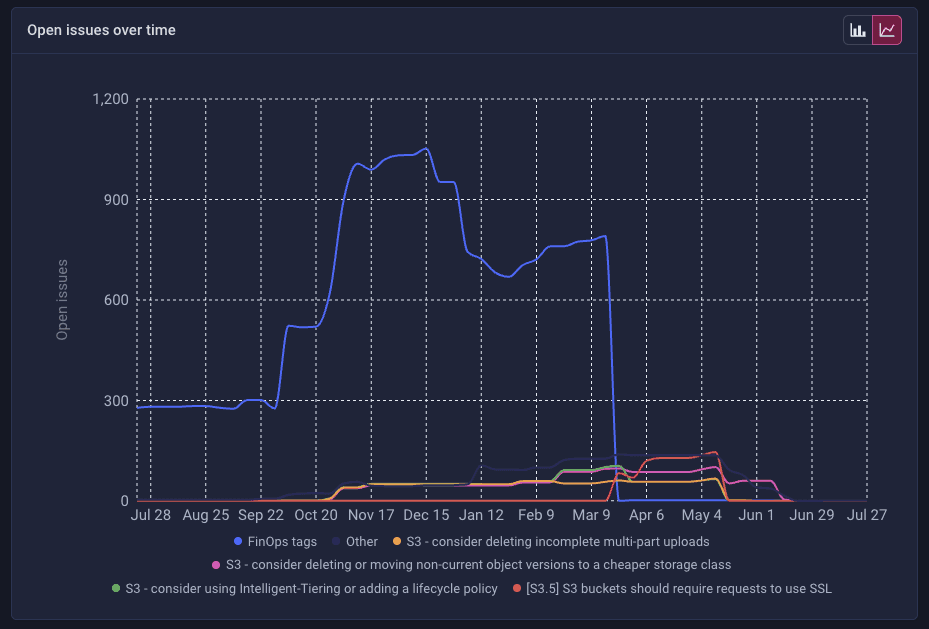
The clearest example came when Infracost surfaced legacy tagging gaps across Vega's infrastructure. Joe used the Infracost Claude skill to automate remediation, a skill that connects to Infracost Cloud and lets platform and FinOps teams automate governance across all of their IaC pipelines.
Joe tested it late one night after hearing about it from the Infracost team. The initial scan took 10–15 minutes to identify every issue, then Claude created pull requests to update the infrastructure, which Joe and his team reviewed and merged across four rounds. He watched his Infracost graph of 761 tagging compliance gaps slope down to zero almost as fast as he could track it.
"It happened so fast, Infracost couldn't even measure the delta," said Joe.
Results
Joe's structural transformation delivered what Vega needed to scale: a modernized platform where infrastructure is correct, cost-optimized, and compliant by default. Vega's engineers can now ship confidently, knowing that cost visibility and policy compliance are built seamlessly into the process, and PR-level cost commentary means the team reviews the financial impact of infrastructure changes before they merge. Earlier growing pains around instance types, legacy tags, and log retention have been structurally resolved.
The Vega team can now safely ship infrastructure with increased velocity and highly reliable cost governance, and because of the automated guardrails, Joe doesn't feel compelled to hire a dedicated FinOps team. "The Infracost Claude skill really impressed me, so now I plan to use it across other possible FinOps policy violations," said Joe. "The goal is to reach zero, which is only a few days away."


